RPC, TPA, RIA, RPA – The Alphabet Soup Nobody Asked For

There are 76 million Gen Xers. The oldest ones just turned 59. Retirement isn’t a distant concept for them anymore — it’s a calendar item. And right behind them is the largest wealth transfer in American history.
The demand for retirement guidance has never been higher. The clarity around who actually provides it has never been lower.
TPA. RPC. RIA. RPA.
If you work in this industry, you throw these around like everyone knows what they mean. Spoiler: they don’t. And increasingly, neither does the industry itself.
Why The Confusion Isn’t Accidental
Here’s what happened. Retirement planning used to be relatively simple to define. You had investments on one side and compliance on the other. The people managing money had their titles. The people managing paperwork had theirs. Everybody stayed in their lane.
Then the work got more complex. Plans got more sophisticated. Regulations multiplied. Participants needed more. Advisors expanded their scope. Administrators started consulting. The lanes disappeared.
The titles, however, did not update.
So now you have an industry full of firms doing genuinely overlapping, deeply intertwined work — all operating under labels that were designed for a simpler time and a narrower job description.
And as retirement moves from background noise to front-page urgency for an entire generation, that confusion has consequences.
Let’s Actually Define The Roles
RIA — Registered Investment Advisor
This one has the clearest definition, because it’s a regulatory title. An RIA is registered with the SEC or state authorities and operates under a fiduciary standard. They are legally required to act in the client’s best interest.
In the retirement space, an RIA typically handles investment selection and monitoring, fiduciary oversight — usually under a 3(21) or 3(38) designation — and portfolio construction within the plan.
The RIA’s lane is the money. How it’s invested, how it’s monitored, how it’s protected. That clarity is useful. What gets complicated is when RIAs — particularly those who specialize in retirement plans — start describing themselves as something else entirely.
Enter the RPA.
RPA — Retirement Plan Advisor
Here’s where it starts getting slippery.
RPA is not a regulatory designation. It’s a market-facing title. It signals specialization — this person focuses on retirement plans specifically, as opposed to general wealth management — but it doesn’t define a legal scope of service the way RIA does.
In practice, most RPAs are RIAs. They carry both. The RPA title is essentially a way of saying: I’m not just managing your neighbor’s brokerage account, I live in the defined contribution world.
And that’s legitimate. Retirement plan advising is genuinely specialized. Plan design strategy, vendor benchmarking, participant outcomes, legislative changes — this is not the same job as picking a stock portfolio. The specialization deserves a name.
The issue is that “Retirement Plan Advisor” describes a focus, not a function. And when everyone in the ecosystem starts calling themselves some version of advisor, it creates a crowded room where plan sponsors can’t tell who’s actually doing what.
TPA — Third Party Administrator
The TPA has been the backbone of the retirement plan ecosystem for decades. Compliance testing. Form 5500 preparation. Plan document support. Contribution calculations. Year-end reporting.
This is essential, unglamorous, highly technical work. Plans don’t function without it. Regulations get violated without it. The whole operation quietly depends on it.
And yet — “Third Party Administrator” is maybe the most unfortunate title in the industry.
Third party implies distance. It implies the firm is peripheral to the core relationship, a vendor brought in to handle the mechanics while the real work happens somewhere else. Administrator implies a narrow scope. Processing. Filing. Execution without judgment.
Neither of those things reflects what the best TPAs actually do. And it’s created a genuine identity problem for an entire category of firms that have quietly expanded their scope while their title told a completely different story.
RPC — Retirement Plan Consultant
This is the title that more accurately describes what the evolved TPA actually is.
A Retirement Plan Consultant operates inside the structure of the plan — not at the edge of it. Plan design strategy. Data interpretation and validation. Compliance oversight. Coordination across payroll, recordkeepers, and advisors. Ongoing optimization. Complex scenario navigation: M&As, controlled groups, plan mergers, advanced structures.
The difference between a TPA and an RPC isn’t just semantics. It’s a fundamental distinction between processing a plan and shaping how it functions.
TPAs administer. RPCs consult.
Many firms that still carry the TPA label are doing RPC work every single day. The title just hasn’t caught up to the job description — which means the industry, and the plan sponsors they serve, don’t fully understand the value sitting right in front of them.
How These Roles Work Together — When It Works
A well-run retirement plan is actually a team sport. Each role has a distinct function, and when everyone is clear on who owns what, the whole thing runs smoothly:
The RIA manages investments and fiduciary oversight — the money is handled, monitored, and protected.
The RPA (often the same firm as the RIA) guides the client relationship and overall plan strategy — the sponsor has a knowledgeable partner keeping the big picture in focus.
The RPC ensures the plan is designed correctly, operates correctly, and evolves as the business and regulatory environment changes — the engine of the plan is running.
The recordkeeper maintains the platform and participant accounts — the infrastructure holds.
Payroll provides the data that drives everything — the inputs are accurate.
Each role is distinct. Each one is necessary. And when they’re clearly defined and genuinely coordinated, the plan serves participants the way it was designed to.
The breakdown happens when the roles blur, the titles mislead, and nobody’s quite sure who owns the hard stuff.
Why This Matters More Right Now Than It Ever Has
Gen X is not a future problem. They’re a present one — in the best possible way.
This is a generation that watched their parents retire on pensions that no longer exist. They’ve been building retirement savings in 401(k)s and defined contribution plans for decades, in a system that was never fully explained to them, by an industry that couldn’t agree on what to call itself.
As they approach retirement age, the complexity of serving them is only going to increase. Decumulation strategy. Income planning. Healthcare costs. Social Security timing. Rollovers. The questions are getting harder and the stakes are getting higher.
The industry needs to be clearer, not more confusing. It needs firms that understand their role and own it — not a fog of overlapping titles and undefined responsibilities.
The Honest Bottom Line
Every firm in this ecosystem is doing important work. The RIA is protecting the money. The RPA is guiding the strategy. The TPA is keeping the plan compliant and operational. The RPC is making sure all of it actually functions together.
The problem isn’t the work. The problem is the language hasn’t kept up with it.
And as the population that needs this the most finally arrives at the door — the least we can do is be clear about who’s answering it.
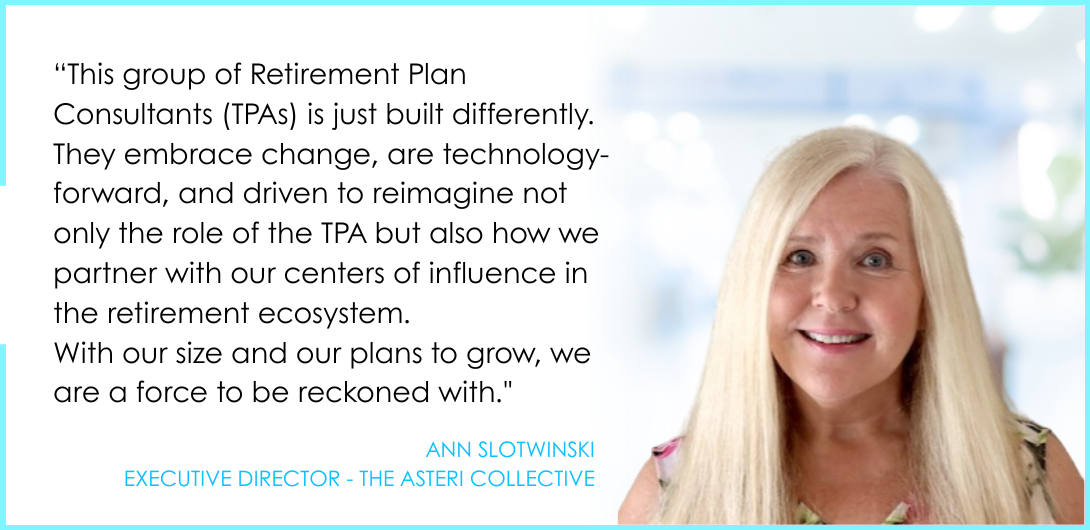
Asteri Collective is a group of independently owned Retirement Plan Consultants shifting the retirement industry from passive to active, from manual to automated, from clunky to streamlined.
FAQs: RPC vs TPA vs RIA vs RPA
What is the difference between a TPA and an RPC?
A TPA, or Third-Party Administrator, has traditionally focused on compliance and administrative functions such as testing, filings, and plan documentation.
A Retirement Plan Consultant (RPC) operates more broadly, overseeing plan design, interpreting data, coordinating between payroll and recordkeepers, and supporting ongoing strategy. The RPC role reflects how many firms operate today, with deeper involvement in how a plan is built and managed over time.
What does a Retirement Plan Consultant (RPC) do?
An RPC focuses on the structure and operation of a retirement plan.
This includes:
- Designing and optimizing plan features
- Ensuring compliance with IRS and DOL requirements
- Interpreting payroll and census data
- Coordinating with recordkeepers, advisors, and payroll providers
- Supporting complex scenarios like ownership changes or multi-entity businesses
RPCs ensure the plan runs accurately and aligns with the goals of the business and its participants.
Is an RPA the same as an RIA?
Not exactly.
An RIA (Registered Investment Advisor) is a regulated entity responsible for investment advice and fiduciary oversight.
An RPA (Retirement Plan Advisor) is a broader, commonly used title for professionals who advise on retirement plans. Many RPAs are RIAs, but the term “RPA” reflects specialization in retirement plans rather than a specific regulatory designation.
What does an RIA do in a retirement plan?
An RIA focuses on the investment side of the plan.
Their responsibilities typically include:
- Selecting and monitoring investment options
- Providing fiduciary oversight
- Supporting participant investment education
- Managing portfolios within the plan
They help ensure that plan assets are invested appropriately based on fiduciary standards and participant needs.
Who is responsible for compliance in a retirement plan?
Compliance is primarily managed by the RPC (or TPA in traditional terms), with coordination across the broader team.
This includes:
- Nondiscrimination testing
- Contribution calculations
- Regulatory filings like Form 5500
- Ongoing adherence to IRS and DOL rules
The RPC ensures the plan meets all technical requirements and operates within regulatory guidelines.
Why are TPAs now being called RPCs?
The term “TPA” reflects a narrower administrative role that no longer captures the full scope of work many firms perform.
As responsibilities have expanded to include plan design, data coordination, and strategic consulting, the term “Retirement Plan Consultant” more accurately reflects the role these firms play in today’s retirement ecosystem.
Do I need both an RPC and an RIA for my retirement plan?
Yes, in most cases.
An RPC and an RIA serve different but complementary roles:
- The RPC focuses on plan design, compliance, and operations
- The RIA focuses on investments and fiduciary oversight
Together, they ensure the plan is both structurally sound and effectively managed.
How do RPCs, RIAs, and recordkeepers work together?
Each plays a distinct role within the same system:
- RPCs design and manage the structure of the plan
- RIAs oversee investments and fiduciary responsibilities
- Recordkeepers maintain participant accounts and provide the platform
- Payroll providers supply the data that drives the plan
When these roles are aligned, the plan operates efficiently and delivers a consistent experience for the sponsor and participants.