The 8 Financial Moves Every Woman Should Make Before Retirement (And Exactly Who to Call)

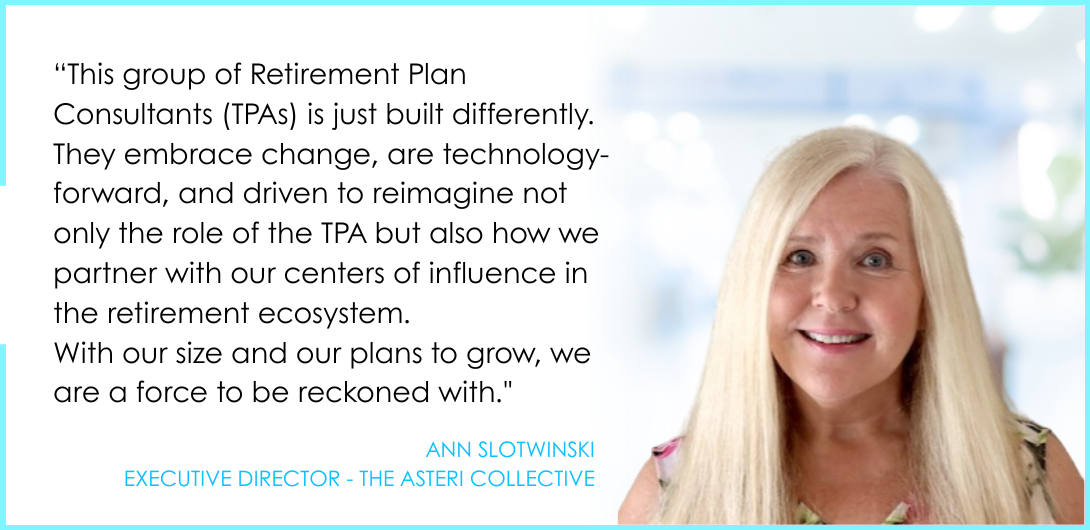
By Ann Slotwinski, Executive Director, The Asteri Collective
July 14th is the first ever Women’s Retirement Security Day, and I want to start with a story we hear constantly across our network of Retirement Plan Consultants.
A woman inherits her father’s pension. He passed away suddenly, the paperwork was never updated, and now she’s on the phone with a plan administrator trying to figure out whether she’s even the correct beneficiary. Nobody warned her that inherited retirement accounts come with deadlines. Nobody told her which professional to call first. She’s smart. She’s capable. She just needed a starting point.
That story isn’t rare. It’s the norm. Women are statistically likely to live longer than their spouses, earn less over a career due to caregiving breaks and the wage gap, and inherit both retirement accounts and financial decisions later in life, often without a roadmap for any of it.
Here are the eight most impactful moves a woman can make to build a more secure retirement, and exactly which professional should be in her corner for each one.
1. Build a Social Security claiming strategy
Claiming Social Security at 62 instead of waiting until 70 can permanently reduce a monthly benefit by up to 30%. For women, this decision carries extra weight: longer average life expectancy means more years living on that benefit, and a lifetime of lower earnings (from the wage gap, career breaks, or both) already shrinks the starting number. Getting the timing right is one of the few decisions that can add tens of thousands of dollars in lifetime income without saving another dollar.
Divorced women may also be eligible for spousal benefits based on an ex-spouse’s earnings record, and widows have their own set of timing rules around survivor benefits. These options are easy to miss and hard to unwind once claimed.
Who to call: A wealth advisor who can model your claiming options against your full financial picture, including spousal, survivor, and divorced-spouse scenarios.
2. Maximize catch-up contributions across every account you have
Once you turn 50, the IRS allows higher contribution limits across 401(k)s, IRAs, and HSAs. Most people never use the extra room, either because they don’t know it exists or because their plan isn’t set up to make it easy.
This is one of the simplest, most immediate ways to close a savings gap in your highest-earning years, particularly for women who took time out of the workforce earlier in their careers and are now trying to catch up.
Who to call: Your Retirement Plan Consultant (RPC – formerly known as TPA), to confirm your plan allows for full catch-up contributions and that your payroll deferrals are actually set to capture them.
3. Plan for healthcare and long-term care costs before you need to
Women face higher lifetime healthcare costs in retirement than men, for a simple reason: they live longer, and are less likely to have a spouse available to provide care later in life. Long-term care insurance premiums are also age-based, meaning the earlier you apply, the more affordable coverage tends to be.
Health Savings Accounts (HSAs), if you’re enrolled in a high-deductible health plan, offer a rare triple tax advantage: contributions are deductible, growth is tax-free, and withdrawals for qualified medical expenses are never taxed. Few people maximize them.
Who to call: A wealth advisor or long-term care specialist, to evaluate coverage options and HSA strategy while you still have the most choices available.
4. Get a trust and estate attorney before you need one
If you’re inheriting assets from aging parents, or thinking about how your own accounts will pass to your children, a trust and estate attorney should be one of the first calls you make. They’ll help you understand how your assets are titled, whether a trust makes sense for your family, and how to avoid the probate delays that catch so many families off guard.
Who to call: A trust and estate attorney, ideally one who has experience with retirement accounts specifically, not just real estate and general estate planning.
5. Confirm your beneficiary designations with your RPC (TPA)
Here’s a detail that surprises almost everyone: your will does not control who inherits your 401(k), your cash balance plan, or your IRA. Your beneficiary designation form does. If that form is outdated, missing, or was never filed correctly, it overrides your will entirely, no matter what your estate plan says.
This is one of the most common and most fixable problems we see. A divorce that happened fifteen years ago and was never updated on the plan paperwork. A parent who assumed a verbal conversation counted as an update. A beneficiary form that simply got lost between recordkeepers.
Who to call: Your Retirement Plan Consultant (RPC or , as some still call us, Third Party Administrator TPA). We have direct access to plan records and can confirm, in writing, exactly who is listed and what needs to change.
6. Understand the tax timing on an inherited IRA
Inheriting money is rarely the hard part. Deciding when and how to take distributions without triggering an avoidable tax bill is where most people get stuck, especially with inherited IRAs.
Since the SECURE Act changed the rules, most non-spouse beneficiaries now have a 10-year window to fully distribute an inherited IRA, and depending on the original owner’s age and distribution history, there may be required withdrawals within that window, not just at the end of it. Get this wrong and you could push yourself into a higher tax bracket in a single year for no reason other than not knowing the rule existed.
Who to call: A wealth advisor who can model out distribution timing against your other income, not just tell you the account exists.
7. Maximize Roth catch-up and executive plan opportunities
Under SECURE 2.0, workers earning above $150,000 in the prior year are required to make catch-up contributions on a Roth basis starting in 2026. That’s not a penalty. It’s a planning opportunity, especially for women who took career breaks and are now in their highest-earning years trying to close a savings gap.
For executives and business owners, cash balance plans and other defined benefit structures can allow for significantly higher tax-advantaged contributions than a 401(k) alone, sometimes six figures more per year depending on age and compensation. These plans work especially well for women in their late 50s and early 60s who are earning at their peak and want to accelerate savings before retirement.
Who to call: Your RPC, who can evaluate whether a cash balance plan or other executive-level plan design fits your situation, in coordination with your CPA on the tax impact.
8. Loop in your CPA before decisions get made, not after
Every one of the moves above has a tax consequence attached to it. Roth catch-up contributions, inherited IRA distributions, cash balance plan funding, even the timing of when you claim Social Security. These decisions don’t happen in isolation, and the version of this planning that works best is the one where your CPA is in the conversation before a decision gets made, not brought in afterward to clean up the paperwork.
Who to call: Your CPA, ideally the same one reviewing your retirement plan decisions alongside your wealth advisor and RPC, not a separate conversation that happens once a year in March.
You’re in Charge of Your Own Future
Every item on this list has one thing in common: it works best as a coordinated conversation, not eight separate phone calls that never talk to each other. A trust and estate attorney who doesn’t know what your RPC is doing with your beneficiary designations. A CPA who finds out about a cash balance plan after it’s already funded. A wealth advisor modeling Social Security timing without visibility into your plan design. That’s how gaps happen.
Women’s Retirement Security Day is a reminder that a secure retirement isn’t the result of one big decision. It’s the result of several smaller ones, made with the right people in the room, early enough to matter.
At The Asteri Collective, this is what our member firms do every day: build the coordinated plans that give women a real starting point, and the confidence that comes with actually understanding their options. If you’re looking for help to gather the right team, ask your RPC (TPA). We work with all of the professionals listed in this article and can make a recommendation for a few trusted people for you to talk to.
If you’re inheriting a parent’s retirement account, sitting on an outdated beneficiary form, or simply haven’t had this conversation yet, today’s a good day to start.
This article is for general informational purposes and does not constitute personalized financial, legal, or tax advice. Individual circumstances vary, and readers should consult a qualified professional before making retirement planning decisions.
Ann Slotwinski is the Executive Director of The Asteri Collective, a coordinating network of Retirement Plan Consultant firms working to elevate the RPC role from administration to strategy across the retirement planning industry.