Platform Dependency Risk in Retirement Plans: What Happens When Your Recordkeeper Controls the Roadmap

The defined contribution ecosystem is larger and more interconnected than ever. Recordkeepers, payroll providers, advisors, Retirement Plan Consultants (RPCs), DCIOs, and technology vendors all operate inside a system that now exceeds $12 trillion in assets. At that scale, infrastructure decisions are no longer operational footnotes. They are strategic commitments.
One of the most underexamined risks in today’s retirement plan environment is platform dependency risk. It emerges quietly when a single recordkeeper controls not only administration, but also data architecture, integration standards, and the product development roadmap. What begins as convenience can evolve into operational concentration, reduced flexibility, and diminished leverage across the ecosystem.
Understanding this risk is not about criticizing recordkeepers. It is about recognizing how structural concentration reshapes power, speed, and optionality inside retirement plans.
What Is Platform Dependency Risk in the Retirement Plan Ecosystem?
Platform dependency risk occurs when a retirement plan’s operations, data flows, and future capabilities become structurally tied to one recordkeeper’s technology infrastructure and development priorities.
In practice, this means the recordkeeper controls:
- The payroll integration framework
- The format and accessibility of plan data
- The participant digital experience
- The implementation timeline for regulatory changes
- The release cycle for new features and tools
When these elements sit inside a single proprietary ecosystem, every downstream stakeholder inherits that roadmap. Advisors and RPCs may shape plan design and compliance strategy, but they do so within the boundaries of a platform they do not control.
That boundary is where concentration risk begins.
Operational Concentration Risk: When Flexibility Narrows
Retirement plans rely on precise coordination between payroll systems, recordkeepers, compliance testing platforms, and consulting teams. When integrations are deeply embedded in one proprietary system, even minor changes can create cascading effects.
A payroll update can disrupt file feeds. A system enhancement can require downstream reconfiguration. A change in data structure can affect reporting or compliance workflows.
In a diversified infrastructure environment, those disruptions are isolated. In a concentrated environment, they are systemic.
Over time, migration costs increase. Extracting clean historical data becomes more complex. Conducting RFPs becomes operationally burdensome. Sponsors may technically retain the right to change providers, but the practical friction discourages movement.
Reduced flexibility is rarely visible in year one. It becomes clear over time.
Innovation Bottlenecks: When Strategy Waits for the Roadmap
The retirement industry is evolving rapidly. SECURE 2.0 implementation, Roth catch-up coordination, lifetime income solutions, decumulation frameworks, cybersecurity enhancements, AI-assisted reporting, and payroll API modernization all require system-level adaptation.
In a platform-dependent environment, innovation timing is determined by the recordkeeper’s internal priorities. If a feature is not on the roadmap, it does not matter how urgently advisors or RPCs believe it is needed.
Strategic differentiation becomes partially outsourced.
For advisory firms competing in an increasingly sophisticated environment, the inability to implement new tools or structures quickly can translate into lost opportunities. For RPC firms positioning themselves as strategic partners rather than administrators, roadmap dependency limits advisory expansion.
Speed is not simply about convenience. It is a competitive variable.
Strategic Leverage and Negotiation Power
Platform dependency risk also affects leverage.
When data access is limited to proprietary portals, reporting formats are platform-specific, and integrations rely on exclusive relationships, switching costs increase. Even if termination fees are modest, the operational lift required to migrate plans becomes significant.
As switching costs rise, negotiation leverage declines.
Fee discussions occur within narrower parameters. White-label flexibility may be constrained. Data transparency becomes mediated rather than direct.
Independence is often framed as an ownership structure issue. In reality, it is also an infrastructure issue. If your operational backbone is fully controlled by one provider, strategic autonomy is partially constrained, regardless of branding.
Fiduciary and Governance Implications
Platform concentration is not merely a business risk. It intersects with fiduciary responsibility.
Plan sponsors are obligated to act prudently and in the best interest of participants. Prudence requires informed oversight. In a highly concentrated platform environment, oversight can be limited by data opacity or restricted reporting flexibility.
As litigation risk grows and cybersecurity scrutiny intensifies, governance expectations are rising. Plan fiduciaries must demonstrate process discipline, vendor evaluation, and risk awareness. If the infrastructure makes vendor evaluation or data portability cumbersome, oversight becomes reactive rather than proactive.
Visibility supports prudence. Architecture determines visibility.
Open Architecture, API Standards, and Ecosystem Collaboration
The alternative to platform dependency is not fragmentation. It is interoperability.
Open architecture environments rely on standardized APIs, shared data definitions, and collaborative technical frameworks. Industry efforts through organizations such as SPARK Institute have advanced API standards that allow payroll providers, recordkeepers, and consulting firms to exchange data more consistently and securely.
When data standards are shared rather than siloed, integration improves across the ecosystem rather than within one environment. Migration becomes feasible. Innovation can occur in parallel rather than sequentially. RPCs and advisors can align plan design strategy with technology capability rather than wait for it.
Interoperability does not eliminate recordkeepers. It balances them.
Designing Retirement Plan Infrastructure With Intent
Convenience should not be confused with resilience.
High-functioning retirement ecosystems are built intentionally. They prioritize clear data ownership, transparent governance, standardized integration protocols, and distributed accountability. They recognize that no single entity should control the pace of modernization for the entire system.
Retirement Plan Consultants occupy a central role in this architecture. They coordinate compliance, plan design, payroll integration, and operational oversight. When their effectiveness depends entirely on a single roadmap, advisory scope narrows. When they operate within interoperable systems, strategic value expands.
Infrastructure is strategy. The two are inseparable.
The Strategic Question for Plan Sponsors, Advisors, and RPCs
Platform dependency risk forces a foundational question:
Are you selecting your partners based on deliberate design, or inheriting structural limitations through convenience?
In a retirement system measured in trillions of dollars and shaped by rapid regulatory change, concentration risk is not abstract. It affects leverage, speed, optionality, and governance.
When a recordkeeper controls the roadmap, they influence not only technology deployment but also competitive positioning and fiduciary posture. Recognizing that dynamic is the first step toward designing more resilient, flexible retirement plan ecosystems.
Rethinking Infrastructure Is Rethinking Strategy
The future of retirement plan consulting depends on more than service models. It depends on architecture.
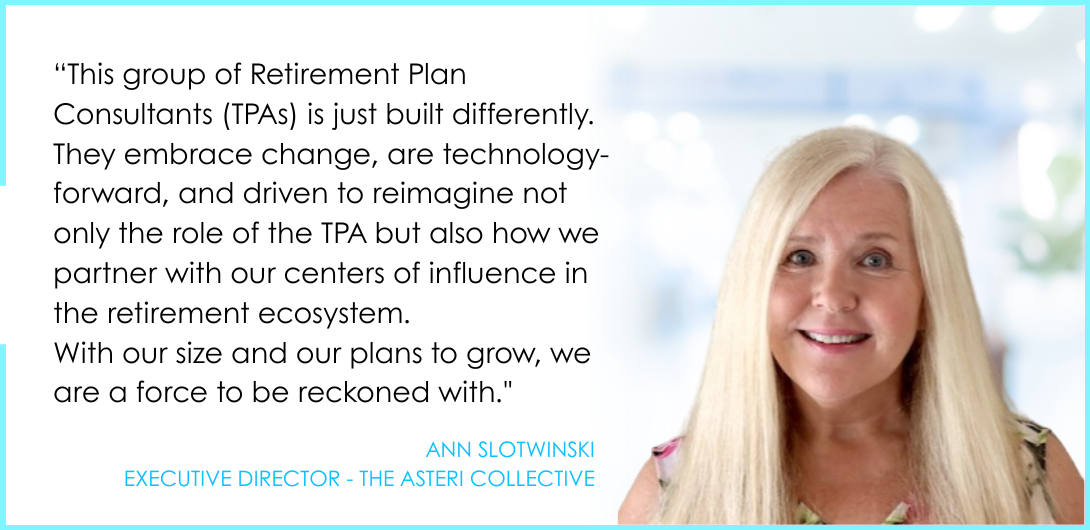
At Asteri Collective, we believe independence is engineered, not assumed. Through collaboration, shared standards, and strategic alignment, we work to strengthen the role of Retirement Plan Consultants at the center of the ecosystem.
If you are evaluating your platform relationships, data strategy, or long-term infrastructure risk, let’s start that conversation.